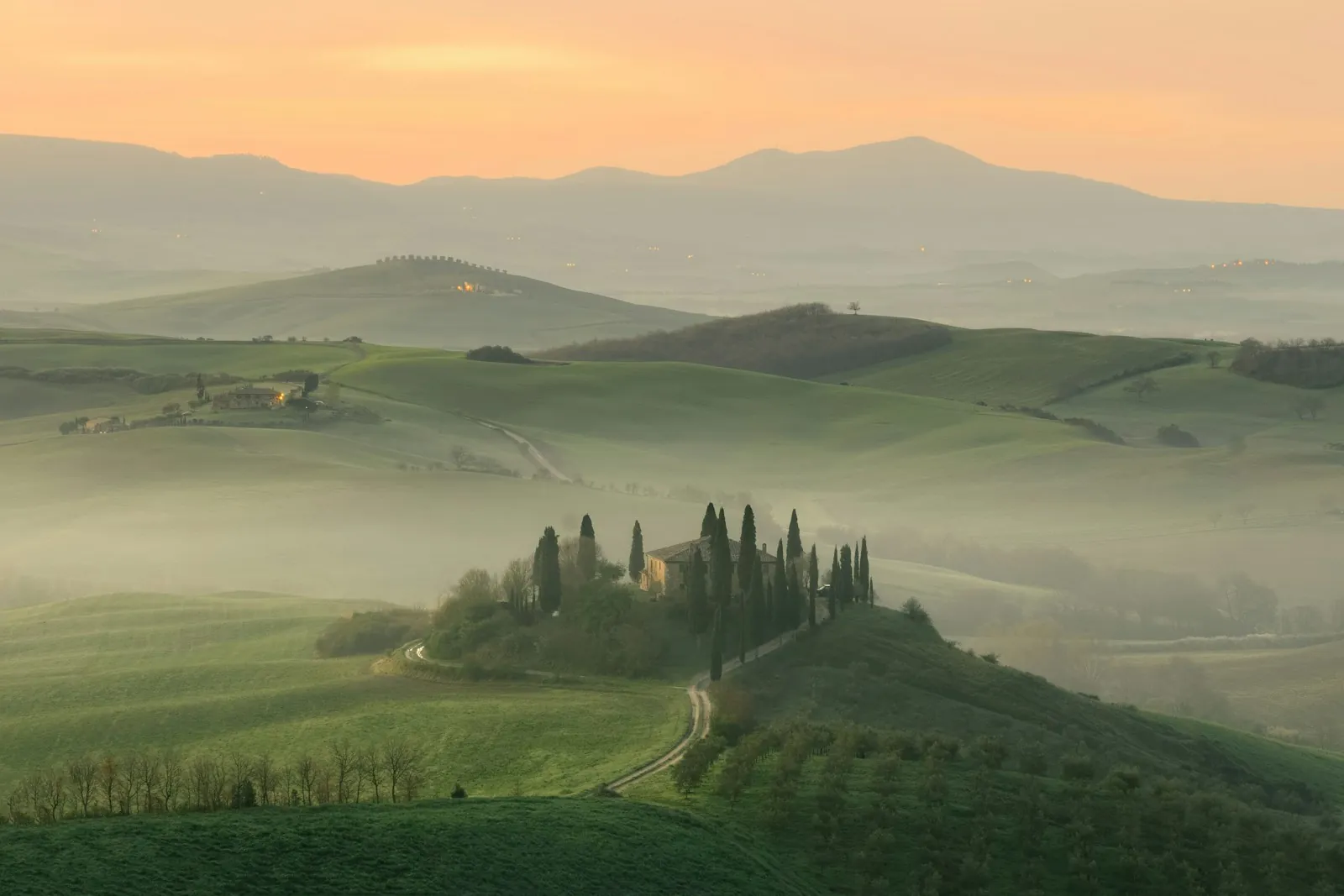
Tuscany rewards a slow week. This five-day route opens in Florence, where you can walk to the greatest hits, then hands you a car from day three to trace the Chianti wine road, the medieval hill towns and the cypress-lined Val d’Orcia. You will not rush, but you will see the essentials, and you will finish in the landscape that made Tuscany famous. If this is your first trip to the region, our Florence first-timer’s guide and the wider Tuscany overview are worth a read before you pack.
Itinerary at a glance
| Day | Area | Signature experience |
|---|---|---|
| 1 | Florence | Uffizi, the Accademia’s David and sunset from Piazzale Michelangelo |
| 2 | Florence | Oltrarno workshops, Boboli gardens and the Ponte Vecchio at dawn |
| 3 | Chianti | Winery drive and a cellar tasting over the vines |
| 4 | Siena and San Gimignano | The Piazza del Campo, the striped Duomo and the surviving towers |
| 5 | Val d’Orcia | Pienza, Montalcino, thermal springs and the cypress avenues |
Day 1: Florence, art and a sunset
Book ahead, always. Reserve the Galleria degli Uffizi and the Accademia, home to Michelangelo’s David, well before you arrive, and give the morning to both. Afterwards, walk to the Cattedrale di Santa Maria del Fiore and climb Brunelleschi’s dome, a steep, narrow ascent that ends face to face with the frescoed cupola and a rooftop view of the city; the climb is timed and ticketed, so confirm slots on the official cathedral site.
For lunch, share a bistecca alla fiorentina, the towering T-bone served rare by tradition, best split between two and not the dish for anyone avoiding beef or red meat. Follow it with a Tuscan pastry and an espresso at a historic café near the centre. As the light softens, walk up to Piazzale Michelangelo for the classic sunset over the Arno and the dome.
Optional guided tour: a skip-the-line Uffizi tour with an art historian turns a vast gallery into a story you can follow.
Wow moment: the Bargello, the city’s quiet sculpture museum, holds Donatello’s bronze David and rarely draws a queue.
Day 2: Florence on foot and across the river
Beat the crowds to the Ponte Vecchio at dawn, when the goldsmiths’ shutters are still down and the bridge is almost empty. Cross into the Oltrarno, the artisan quarter, and wander the leather, gilding and bookbinding workshops that still keep the old crafts alive. Mid-morning, escape into the Giardino di Boboli behind Palazzo Pitti, a sculpted Renaissance garden made for slow walking; entry is modest, roughly €10 to €15, so confirm current prices at the gate.
For lunch, join the locals at a lampredotto stand for Florence’s tripe sandwich, a rich, savoury street food that is not for the squeamish or for vegetarians, then take wine by the glass at a tiny hole-in-the-wall enoteca. Many pour a Chianti or a Vernaccia for just a few euros a glass.
Optional guided tour: an Oltrarno artisan walk that takes you inside working studios.
Wow moment: the Basilica di Santa Croce, whose cloisters hold the tombs of Michelangelo and Galileo, feels like a hidden pantheon of Italian genius.
Day 3: Into the Chianti hills
Collect your car and head south into Chianti Classico country. Before you drive, read our Chianti wine road guide and note the ZTL rules: many historic centres are closed to non-resident cars and cameras issue fines automatically, so always park outside the walls. Our ZTL guide explains how the zones work.
Spend the day looping between villages and estates. Book a Chianti Classico tasting at a working winery, usually €20 to €40 for a guided flight with a cellar visit, and confirm times ahead as many require reservations. Lunch on hand-rolled pici or pappardelle at a village trattoria; ask for the vegetarian pasta of the day, which most kitchens do well.
Optional guided tour: a small-group Chianti wine tour with a driver, so nobody has to skip the tasting.
Wow moment: a cellar visit that opens onto a terrace above the vines, where the tasting continues with the valley falling away below you.
Day 4: Siena and San Gimignano
Drive to Siena and park outside the centre. The shell-shaped Piazza del Campo is one of Europe’s great squares, and the striped Duomo di Siena is a marble marvel inside and out; cathedral entry runs around €8 to €15 depending on the ticket, so check the official site. Try panforte, the dense medieval fruit-and-nut cake, and note it contains nuts for anyone with allergies.
In the afternoon, continue to San Gimignano, the town of surviving towers rising from the hills. Climb one for the view, then cool off with a world-champion gelato on the main square; expect a couple of euros a scoop.
Optional guided tour: a Siena walking tour that includes the Duomo’s inlaid marble floor.
Wow moment: the Abbazia di San Galgano, a roofless Gothic abbey open to the sky, with a sword said to be set in stone nearby, sits a short drive west and sees few visitors.
Day 5: The Val d’Orcia
Save the best landscape for last. Drive the cypress-lined roads of the Val d’Orcia, a UNESCO-listed cultural landscape and the single most photographed countryside in Italy. Stop in Pienza for pecorino cheese and Renaissance views, and in Montalcino for the mighty Brunello wine; tastings here often start around €15 to €25. End at the thermal springs of Bagno Vignoni, where a piazza is filled by a steaming Renaissance pool. The central pool is for looking, not bathing, but nearby spa terraces and free natural pools downstream allow soaking; check locally which are open and safe before you enter the water.
Optional guided tour: a photography drive built around the golden-hour light on the cypress avenues.
Wow moment: the tiny Cappella della Madonna di Vitaleta, a lone chapel framed by cypresses, is the shot every photographer chases.
Practical tips
- Book Florence’s big three, the Uffizi, the Accademia and the dome climb, weeks ahead in high season.
- Take the train between cities if you prefer, though the countryside from day three really needs a car; see our Italy trains guide and driving in Italy.
- Time your trip with our weather by month guide; late spring and early autumn are ideal.
- If your dates fall in late autumn instead, the wine country that comes into its own then is Piedmont’s Langhe, where Alba’s white truffle season runs from roughly October into January.
- Would you rather see three cities than one region? Our one-week Rome, Florence and Venice route covers that week, and is honest about what the moves cost.
- Confirm all opening hours and prices with official sources, as they change with the seasons.
- Deciding where to base a first trip? Our Rome or Florence and Italy first-timer’s guide can help.