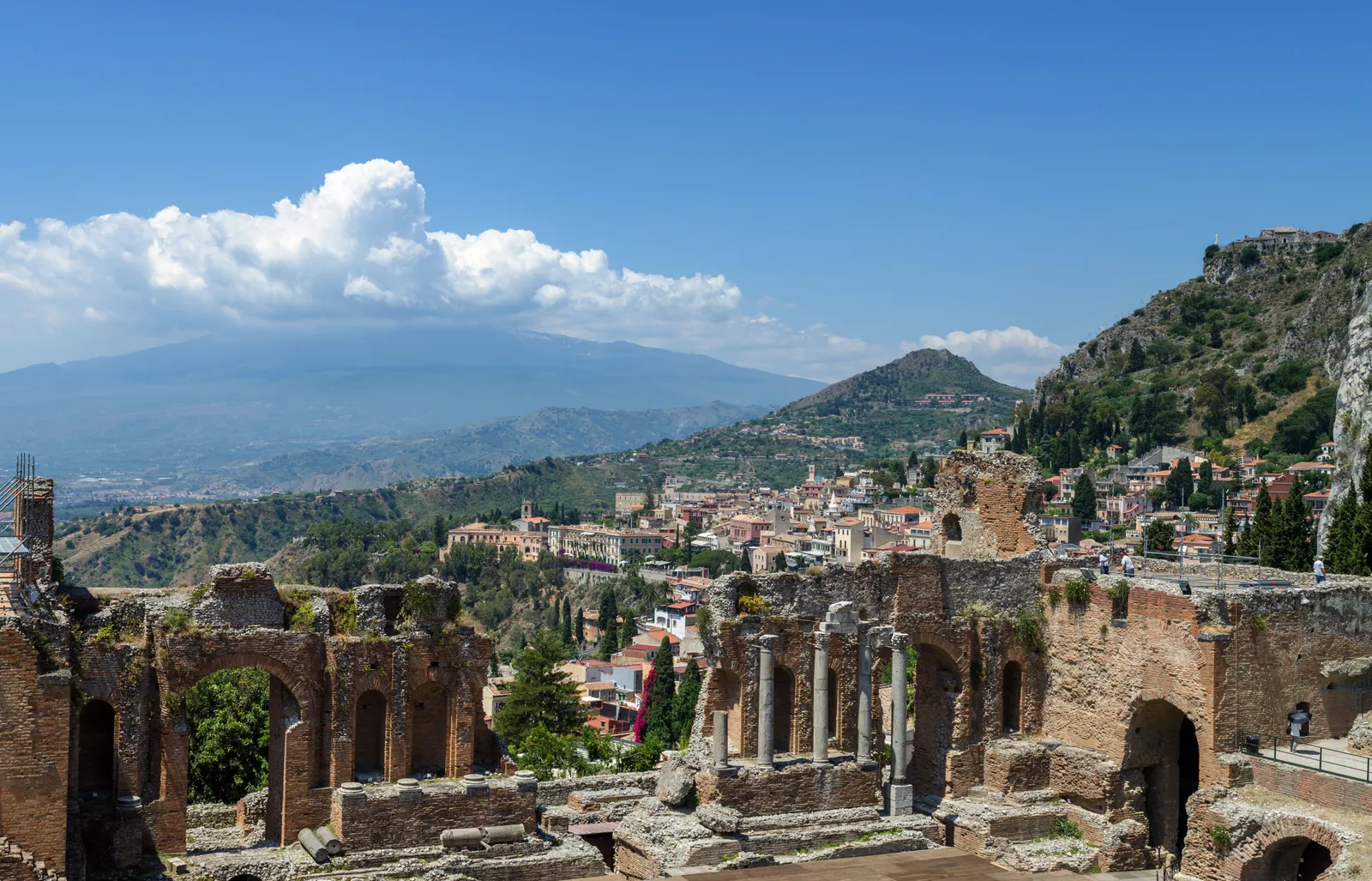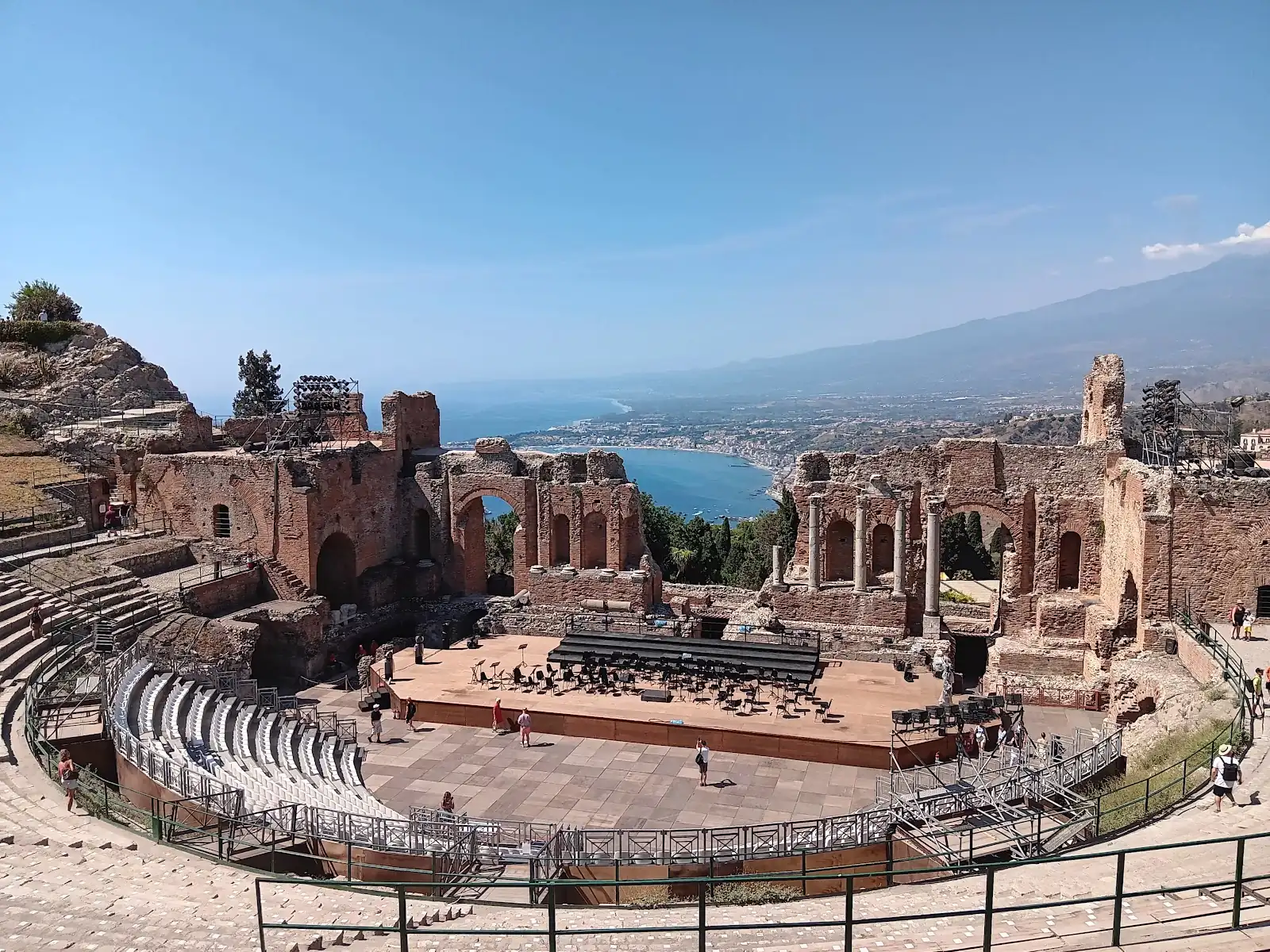
The first time I walked into the ancient theatre in Taormina I actually laughed out loud, and the man selling tickets just nodded like he had seen it a hundred times a day. You climb the stone steps expecting a nice ruin, and then you turn around and the whole back of the stage has fallen away, and there, filling the gap, is Mount Etna with a thin ribbon of smoke coming off the top. The Greeks built it facing that view on purpose. Taormina and Mount Etna belong together, the polished clifftop town and the restless volcano behind it, and getting the balance right between the two is what makes a trip here work.
I went in late May, which I would recommend. The town was busy but not suffocating, the sea was warm enough for a quick swim, and Etna still had a cap of snow that made the whole thing look faintly unreal.
Getting here, and the last leg up the hill
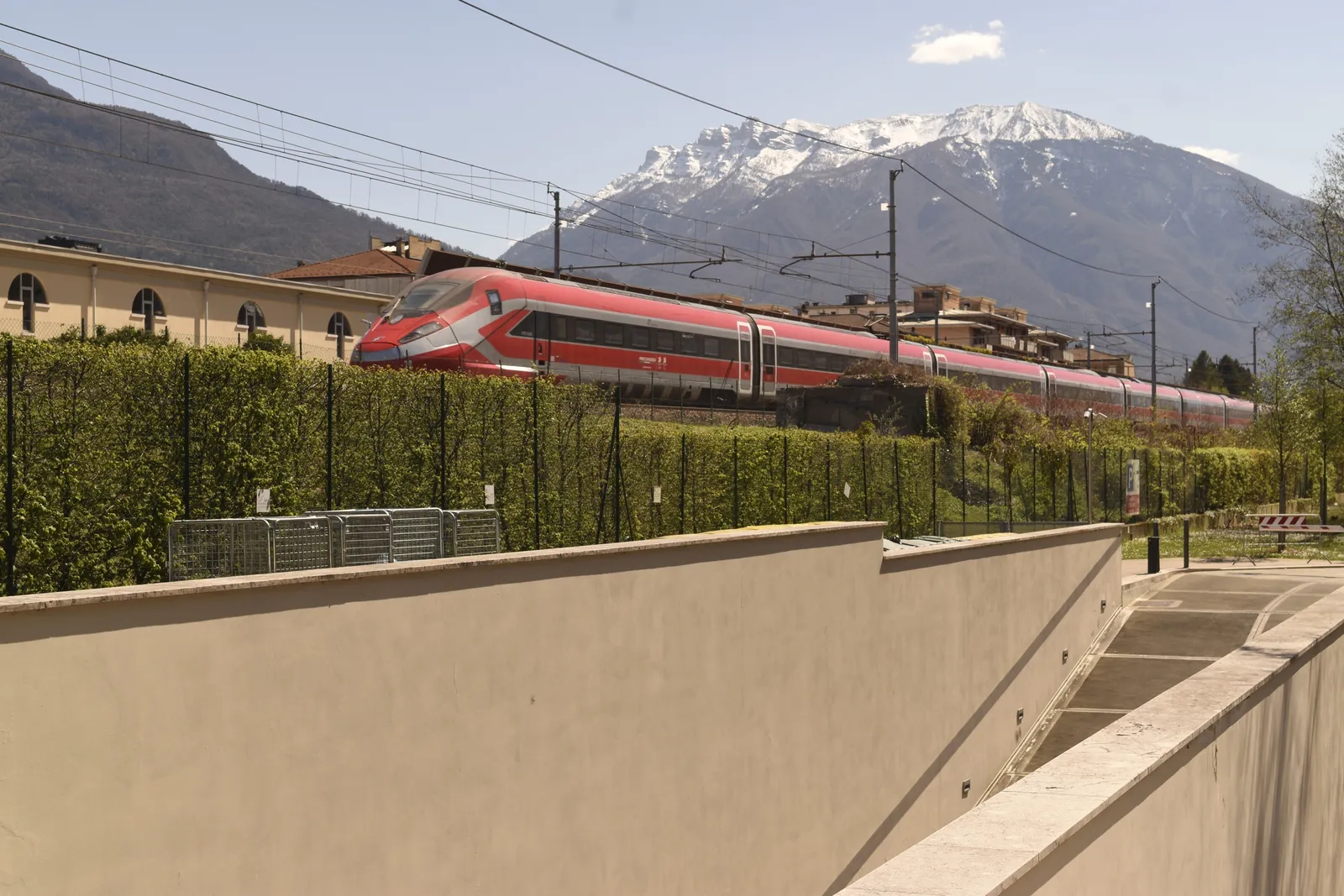
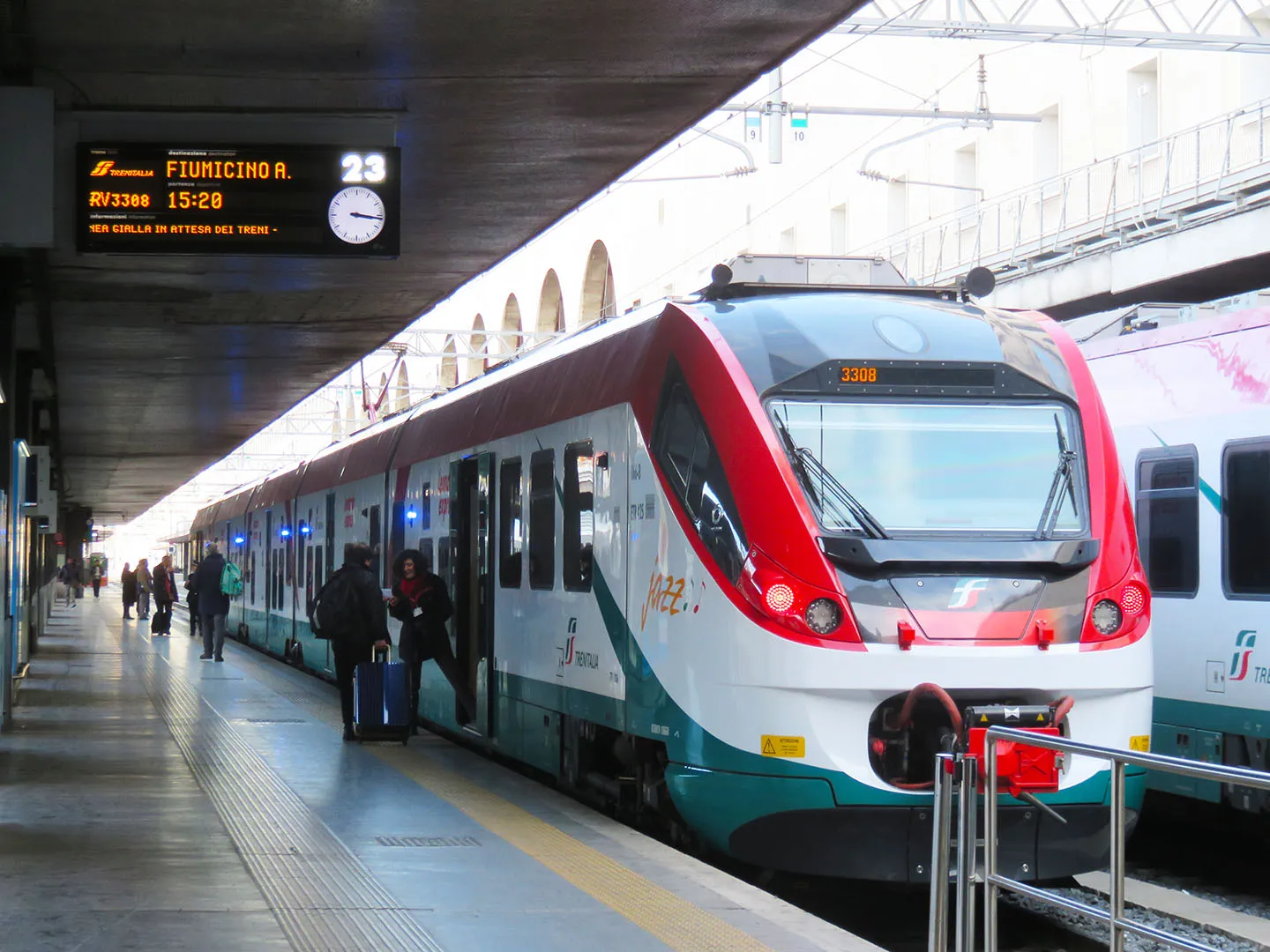
Catania is the practical gateway, with the nearest airport and the best onward connections, and it sits a little under an hour down the coast. From there you have two sensible options. The coastal railway between Messina and Catania stops at Taormina-Giardini, which is a scenic and cheap way to arrive, with the significant caveat that the station is at sea level below the town rather than in it, so the last leg is a bus or taxi up the switchbacks. Our guide to getting around Italy by train covers how the regional and Intercity services on this line work, and why booking behaves differently from the high-speed routes on the mainland.
The alternative is a transfer or hire car straight from the airport, which is easier with luggage and worth the money if you are arriving late. Plenty of visitors reach Sicily via Rome rather than flying in directly, and if that is your route, our guide to Rome airport transfers covers the first hop into the city or across to your connecting flight.
One thing to plan for: Taormina’s old town is largely pedestrian and parking is limited and paid, so a hire car collected on arrival will spend three days in a garage. If Etna and the wine country are the plan, consider picking the car up on the day you need it rather than at the airport.
The Greek theatre with Etna framed inside it
The Teatro Antico di Taormina is the thing everyone comes for, and for once the hype is deserved. It was built by the Greeks and later reworked by the Romans, and it is still used for concerts and film screenings in summer. Tickets cost around 14 euros for adults, and I would check the current price and any event closures before you go, because a rehearsal can shut parts of it.
Go early or go late. I made the mistake of arriving at midday and spent as much time waiting for a clear photo as looking at the view. By half past nine in the morning the light is softer, the coaches have not yet emptied, and you can actually sit on the upper tiers with a coffee and take in the double act of the Ionian Sea on one side and the volcano on the other.
Wandering the town itself
Corso Umberto, the main pedestrian street, runs the length of the old town and is lined with granita bars, ceramic shops and more linen than you will ever need. It is touristy, no argument, but stepping off it into the side lanes rewards you quickly. Piazza IX Aprile has that famous checkerboard terrace looking out to sea, and it is genuinely worth the cliche. Try a granita di mandorla with a warm brioche for breakfast, roughly 4 to 6 euros, and you will understand why Sicilians treat it as a meal.
The other thing Taormina does well is height. The public gardens, the Villa Comunale, are a shaded, almost empty counterpoint to the Corso and have their own sea view, and they are the best place in town to sit out the hottest part of the afternoon. Above the town, the tiny village of Castelmola clings to a crag with an even wider panorama, reachable by a short bus ride or a steep walk, and it is where locals send you when you say the Corso felt crowded.
The beaches and the cable car down
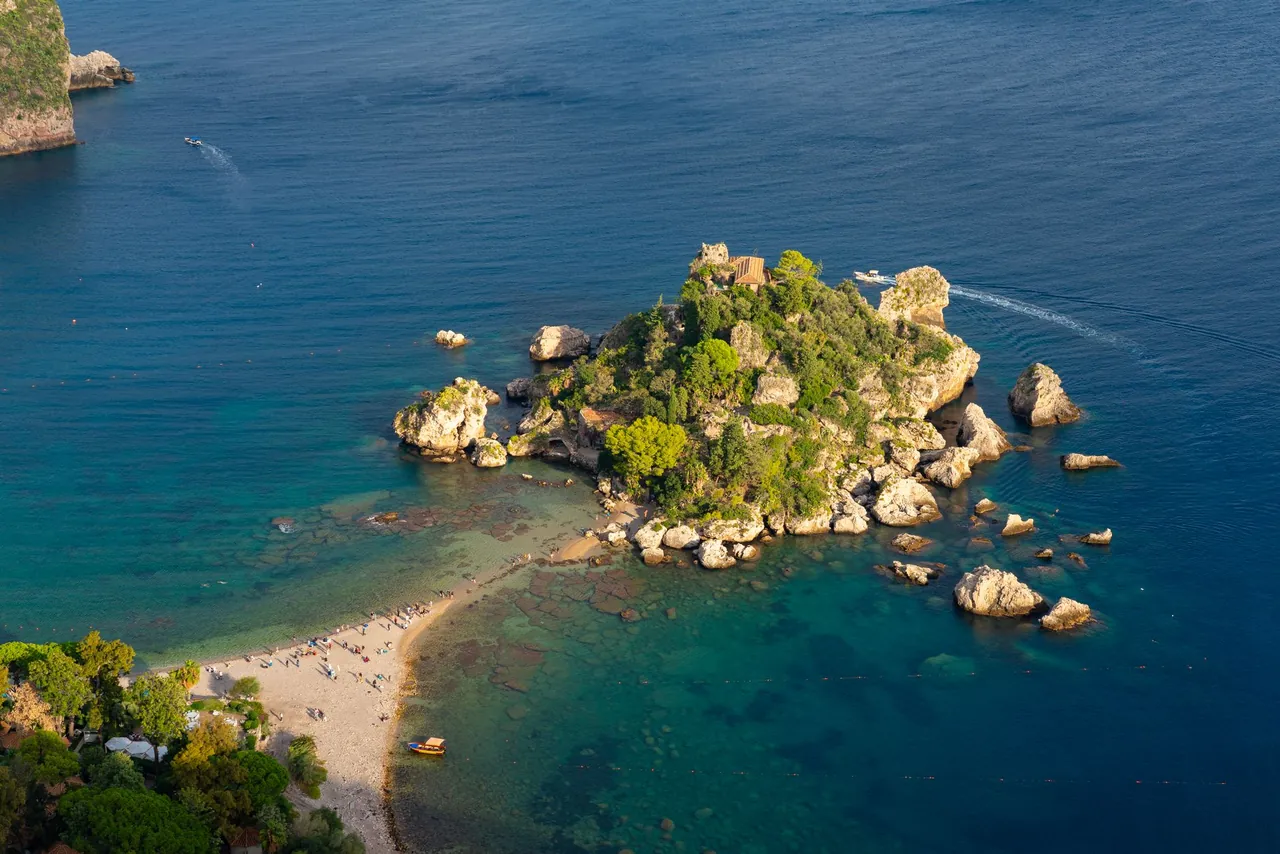
Taormina sits high on its cliff, and the beaches are far below at Mazzarò and Isola Bella. You can walk the switchbacks, but in July heat that is a punishing idea. The cable car, the funivia, runs from the edge of town down to the shore in a couple of minutes. A single ticket is around 3 euros and a return around 6, with day passes available, and it runs frequently through the day, though I would confirm the last departure so you are not stranded at the bottom.
Isola Bella is the little island tied to the mainland by a thin spit of pebbles. It is beautiful and it is also crowded, and the beach is stones rather than sand, so bring water shoes. Sun loungers on the private stretches run from around 15 to 25 euros for two with an umbrella. The free public sections exist but fill early. The islet itself is a protected nature reserve with a separate small entry fee, and it is a short, pretty visit rather than a half day.
If sand matters to you, be honest with yourself before booking: Giardini Naxos, immediately south, has a proper long sandy beach and costs less to sleep in, at the price of Taormina’s clifftop drama.
Etna excursions, chosen by level
This is where people either overplan or underplan. Etna is Europe’s most active volcano and it is huge, so how you visit depends entirely on how much effort you want to put in. Here is roughly how the options stack up.
| Option | Effort | Rough cost per person | Good for |
|---|---|---|---|
| Half-day bus tour to the base | Low | 40 to 60 euros | First look, families, short on time |
| Cable car plus 4x4 to 2900m | Medium | 65 to 90 euros | Getting high without a long hike |
| Guided crater hike with volcanologist | High | 90 to 130 euros | Fit walkers who want the summit zone |
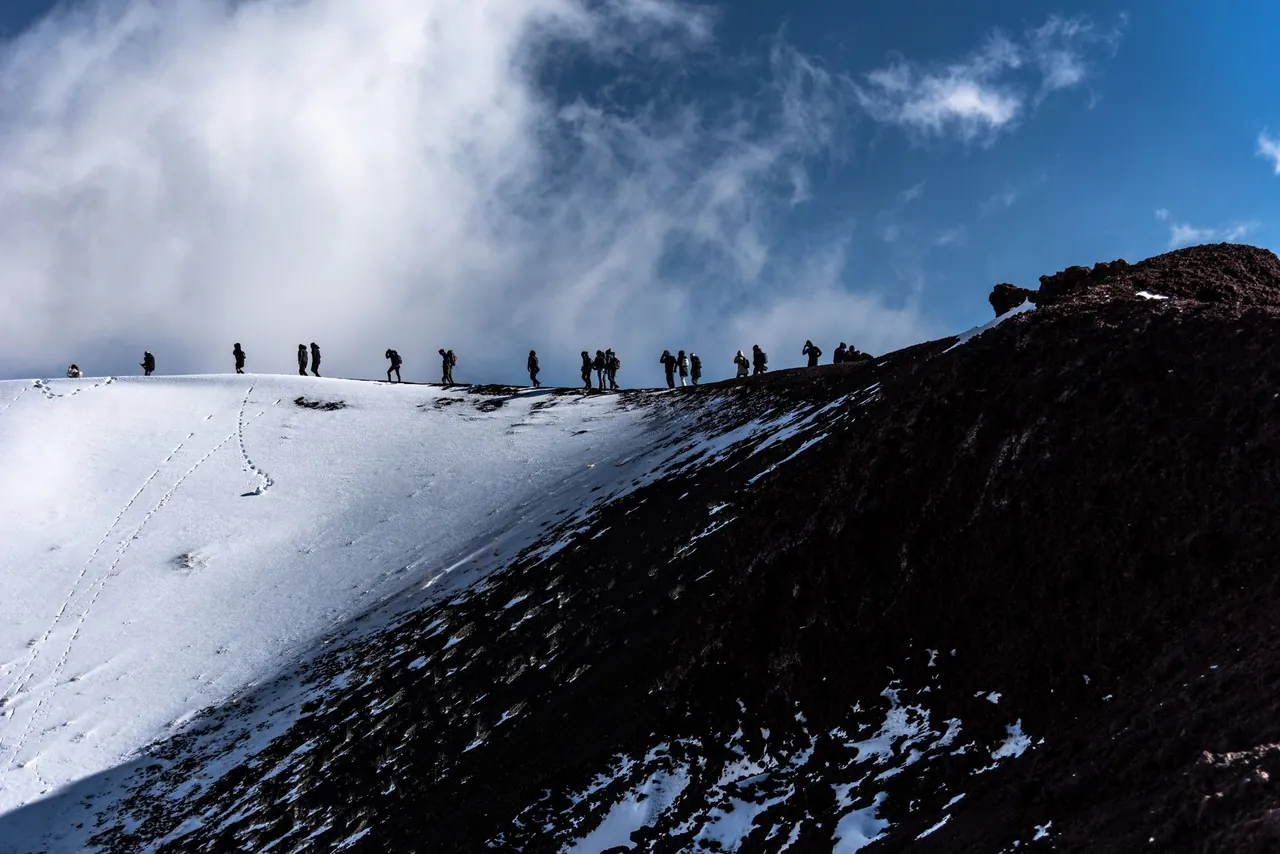
The base area at Rifugio Sapienza, around 1900 metres, you can reach by car or the AST bus from Catania. From there the Funivia dell’Etna cable car climbs higher, and above that authorised guides run you towards the active craters. You cannot legally go into the upper summit zone without a certified guide, and that rule exists for a good reason: conditions change fast and the volcano genuinely does erupt. I would never treat that as a formality.
Whatever level you pick, dress for it. I have been up there in shorts feeling foolish while the wind cut straight through me. It can be 30 degrees in Taormina and close to freezing on the upper slopes, with strong sun and loose ash underfoot.
The two sides of the mountain
Most excursions from Taormina go to the southern side, which is where Rifugio Sapienza, the cable car and the largest tourist infrastructure sit. The northern side, above Linguaglossa, is quieter, greener and forested, and it is the one to choose if you want the mountain without the coach park. The wine country is on that side too, which makes a northern Etna day and a tasting a natural pairing.
Put your Etna day early in your stay rather than last. Access to the higher zones is suspended when activity increases or the weather closes in, and it is far better to discover that on day one with two days in hand than on the morning of your flight.
 Staying the night in Taormina?Sea-view stays and cheaper Giardini Naxos options, many with free cancellation
The wine grown on the slopes
The northern and eastern flanks of Etna have become one of the most talked-about wine regions in Italy, and tasting here is one of my favourite ways to spend a slow afternoon. The reds are made mainly from Nerello Mascalese and taste lighter and more mineral than you expect from Sicily, almost Burgundian, grown in black volcanic soil at real altitude. The whites, from Carricante, are crisp and saline.
Many wineries around Linguaglossa, Randazzo and Milo welcome visitors, and a tasting with a few pours and some local cheese and bread usually runs from around 25 to 45 euros. Book ahead, because the good ones are small and fill up. If you are driving yourself between them, remember the mountain roads are narrow and winding, and Italy’s drink-drive limits are strict, so a designated driver or a booked tour is the sensible call.
What makes these wines worth the detour is the altitude. Vines here grow high on volcanic terraces, which gives cool nights, a long ripening season and a freshness that has very little to do with the heavy Sicilian reds of reputation. Many estates still work old bush-trained vines, some of them very old indeed, and the good ones will happily walk you out into the terraces before you taste anything.
Eating in Taormina and Catania
Sicilian food deserves as much of your attention as the volcano. Start with granita and brioche for breakfast, in almond, pistachio, coffee or lemon. Eat arancini, the fried rice balls that Catania makes conical and calls by a slightly different name than Palermo does, and order pasta alla Norma, aubergine, tomato and salted ricotta, which is Catania’s own dish. Finish with cannoli filled to order rather than sitting pre-filled in a case.
The best value is not in Taormina. Corso Umberto and the main square charge a view premium, and a short bus or train ride to Catania buys you a completely different scene: the raucous morning fish market, cheap seafood, and street food that Sicilians actually queue for. Even in Taormina, walking five minutes off the main drag changes both the price and the cooking.
Day trips that are worth the half day
Three stand out. The Alcantara Gorges, north of town, are a narrow basalt canyon carved by an old lava flow, where you can wade into freezing water between black walls, which is a considerable relief in August. The villages of Savoca and Forza d’Agrò in the hills are where several of the most famous Sicilian scenes in The Godfather were filmed, and the bar in Savoca still trades on it happily.
And Catania itself deserves more than an airport transfer. It is grittier and more lived-in than Taormina, built in black lava stone after the eruptions and earthquakes of its history, with a baroque centre, a great market and a student energy that the clifftop town does not have.
How long to stay and where to base yourself
Give it three nights minimum. One day for Taormina and its beaches, one full day for Etna, and one to breathe, taste some wine, or take the boat trip round the coves below the town. Taormina itself is the most comfortable base but also the priciest. Giardini Naxos, just below, is cheaper and has proper sandy beach, while Catania is the practical arrival city with the airport and the best street food, the fish market especially.
Four nights is better if you want both a wine afternoon and a day trip, and it also gives your Etna day somewhere to move to if the mountain closes. Beyond five nights, most people are better off pushing on to another part of Sicily than adding days here.
What to pack and what to expect
Layers, and more of them than the coastal weather suggests. A fleece and a windproof jacket feel absurd when you pack them for a Sicilian summer and entirely sensible at 2,900 metres. Add sturdy shoes with grip for the ash, sunglasses, high-factor sunscreen and a hat, since the sun at altitude is fierce even when the air is cold. Guides usually provide boots and jackets on the higher excursions, but confirm that when you book rather than assuming.
Bring water shoes for the pebbles, cash for the smaller places, and a refillable bottle. And accept that Sicily runs at its own pace: shops close in the afternoon, dinner is late, and a plan that depends on everything running to the minute will frustrate you long before the volcano does.
What is worth it and what is not
Honestly, some of Corso Umberto is a shopping street dressed up as an experience, and the restaurants right on the main square charge a view premium for average food. Walk five minutes off the drag and prices drop and quality rises. The Etna summit hike is worth every euro if you are fit. The lowest bus tours can feel like you paid to look at the mountain from a car park, so read the itinerary carefully before booking. And do sort your cover before you go, because active-volcano hikes and adventure activities are exactly the sort of thing worth checking in our travel insurance for Italy guide.
Taormina and Etna together give you the two faces of Sicily in one short trip: the elegant, sea-facing town and the raw, smoking mountain that made the soil so rich in the first place. Which side pulled you in more, the theatre with its impossible view or the climb up the volcano? Tell me in the comments.